Solyndra Observations

tl;dr: There’s a reason they call it risk capital.

As you’re doubtless aware, Solyndra announced yesterday that it’s shutting down. The CIGS-on-tubes solar module maker raised nearly $2 billion in capital, including more than $1 billion from venture investors and a $535 million government loan. This event is being commentated to death (and will continue to be well into next year’s election, IMHO), but there are a couple of oddly-absent points that deserve raising:

  • This was about manufacturing yield, not cheap silicon or China Inc. There’s a common thread running through most of the coverage that goes something like “Solyndra was surprised by a one-two punch of plummeting silicon prices and Chinese solar capacity.” I can’t possibly believe that: Solyndra’s managers and investors were smart people deeply immersed in the solar market and very aware of what economic $/W would be a few years’ hence. My understanding is that the business plan anticipated low-cost competition and expected to win on economics, but manufacturing yields didn’t hold during scale-up and the effective cost of the product ballooned. (I note that Ted Sullivan at Lux Research spotted this in between the lines of the company’s aborted S-1 way back in December of 2009.)
  • Failure is a fact of life in venture investing – and energy innovation. VCs provide capital to high-risk businesses that can’t be funded any other way. Most venture investments either fail completely or deliver mediocre returns. Cases like Solyndra come with the territory, and they say no more about all the other VC-backed energy start-ups than Webvan said about Amazon: The whole point is to risk failure, because you have to take on many (informed, balanced, and uncorrelated!) bets for a shot at a big outcome. Those outcomes, in turn, pay for the failures many times over – while improving lives and creating jobs. There’s a legitimate argument about whether taxpayer money should be deployed in this pursuit, but to treat even a very costly cratering like this one as anything other than de rigeur seems silly.
Posted in Current events, Solar | 1 Comment

How the Republican Field Talks about Energy

tl;dr: No Perry = no energy debate in 2012.

After the passing mentions of energy in last Thursday’s Republican presidential debate, I wondered if I could measure how big a deal this topic is to the candidates. Do they see it as a big issue or a small one? What’s the balance of attention between fossil fuels and renewables? Does anybody still talk about carbon? While the weekend realigned the field quite a bit – Bachmann won Ames, Perry’s in, Pawlenty’s out – the question remained, so I went at it today.

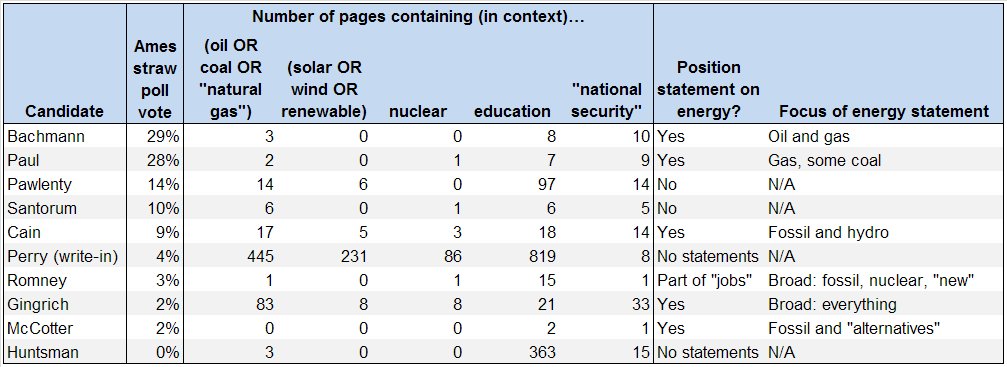
I wanted as like-for-like a comparison as I could get on how the candidates are thinking about energy, so I used their campaign websites: Everybody’s got one, the sites should reflect carefully considered positions, and they’re not subject to reporting bias. I looked at the sites of the nine candidates who ran in Ames plus write-in Rick Perry, and I did two things. First, I ran Google searches on terms like “energy,” “nuclear,” and “renewable” to see how many pages on each site mentioned each, taking this as a proxy for importance (I used searches on non-energy terms like “education” and “national defense” as a baseline). Second, I looked at the sites’ formal position statements to see which candidates had ones on energy, and if so what they focused on. Here’s what I found:
  • Everybody name-checks energy as a topic… In fact, most candidates’ sites register more hits on “energy” than on “education,” “health care,” “immigration,” or “national defense.” (I’m not including raw data on this because some sites put these terms into their navigation, making them show up on every page and messifying my data, but when these cases are removed the trend is clear.)
  • …but only half elevate it. Only five candidates call out a specific position statement on energy. We can bring it up to six with Romney, who embeds four sentences on energy discussion within his “job creation” statement. To the extent that word count tells us something about the importance of a given issue, note that the energy-focused statements have 53% of the words of the average position statement…
  • It’s mostly about fossil fuels – specifically, expensive gasoline. Every candidate except margin-of-error guy Thad McCotter has a reference to oil, coal, or natural gas somewhere on his or her site; the median number of mentions is 4.5. Most of these are about the high price of gasoline (note that Bachmann’s formal position statement on energy is titled “Affordable Energy.”) In contrast, only six of 10 candidates’ sites ever use the world “nuclear” in an energy context (median of 1 mention), and just four ever use the words “solar,” “wind,” or “renewable” (again, in an energy context; median of 0 mentions). Of the six position statements that include energy, four mention nuclear and three mention renewables.
  • Carbon looks like a third rail. Only Perry’s and Paul’s sites have any hits on “carbon,” “global warming,” or “greenhouse gas,” and they’re all from republished news articles – meaning that zero Republican candidates proactively address carbon on their web sites. Note that while this means none of them explicitly call out support for carbon regulation (not exactly a popular Republican position), none of them proactively hate on it either, which is something of a surprise. My take is that carbon has become a third-rail issue that nobody can benefit from, so candidates try to avoid being on record on the topic.
  • The EPA gets particular scorn. Of the six sites with formal position statements on energy, four of them refer negatively to the EPA and/or environmental regulation, and two of them – from Paul and Gingrich – call to shut the EPA down altogether. (There’s one contrary position: Although McCotter doesn’t say anything explicitly about the EPA, his energy statement advocates environmental protection, so one can assume he’d be pro…)
  • Perry is the only candidate playing offense on energy. My philosophy of electoral politics is that candidates can choose to play offense or defense on any given issue. If they’re on offense, they’re trying to use the issue as a differentiator, so they proactively bring it up and try to score points with it. If they’re on defense, they try to avoid mentioning it unless the opponent does. The only Republican candidate playing offense on energy seems to be Rick Perry: His site is full of accolades about Texas’s high level of wind penetration and how shale gas has contributed to the state’s economy. Bachmann runs a very narrow energy play focused on the cost of gasoline, and to everyone else energy looks like a secondary or tertiary issue.

My big takeaway is that energy is going to be a non-issue in the 2012 campaign unless Perry becomes the Republican nominee. I don’t think Obama will make a big deal out of energy: It risks raising too many negatives, like lackluster green job creation and Solyndra’s loan guarantee debacle. If Perry makes the general election, however, it’s a different ball game: Texas’s economy is so tied to oil and gas that energy must be a part of his economic message, and his wind-friendliness could help attract independents during the inevitable tack toward the center. Without Perry, however, no candidate has much to gain from emphasizing energy in 2012.

Posted in Policy | Leave a comment

Chinese Electric Bus Fire

tl;dr: Scary pics.

Looks like an EV bus caught on fire in Shanghai yesterday – specifically, a hybrid ultracapacitor/Li-ion bus. Thankfully no one appears to be hurt, but doubtless this is going to call into question the safety of the current generation of Li-ion batteries. More detail at Green Car Reports.

[Photo via Eastday, with lots more scary-looking ones where that came from.]

Posted in Current events | 1 Comment

Aspen Aerogels S-1 Analysis

tl;dr: Good company; tough road in the rear-view mirror.

Aspen Aerogels filed for an IPO last week, pitching itself as an energy efficiency company. Aspen makes insulation, but a particularly high-performing kind of insulation, being a nanoporous silica material that’s about 97% air by volume. I’ve been tracking this company since 2004 and think highly of its CEO Don Young (the only cleantech CEO I know with a baseball career, having played minor league ball for a Braves farm team).

To me, SEC filings are dry only like a fine wine – I devour these things because numbers reveal truth. Here are the big numbers for entrepreneurs from the S-1:

  • 10 years. Materials businesses take a long time, at least those with a substantial top line (i.e., not licensing plays). Aspen took its first VC money in May 2001, so it’s been north of a decade. And that’s with the unfair advantages of a big price/performance leap and a great management team; adoption and scale-up time frames are just really difficult to compress for physical goods. If you’re contemplating a start-up here, you and your partners need to be in it for the long haul.
  • $200 million. It’s not enumerated in the S-1, but adding up past financing announcements it looks like Aspen raised around $200 million in total capital, including north of $50 million in debt, over ten years and nine rounds. That’s not a crazy figure for a manufacturing company (A123Systems raised more than $300 million prior to its IPO), but it does underscore the capital intensity in many domains of cleantech.
  • 18-for-1. That’s the tough medicine that common stock holders – in particular, management and employees – had to swallow when the company recapitalized in 2008: Every 18 shares of common stock turned into one share. This was part of a complex transaction that appears to have been designed to give the investors a large enough level of ownership to justify continued funding. (In addition, a second recap in 2009 seems to have wiped out the preferred stock from the first few rounds of investment.) While I imagine the company re-upped the people it felt it had to retain, if you were a founder holding common stock (or worse yet a rank-and-file employee holding options), both of these events would have been really bad for you –unless you’d negotiated protection beforehand.
  • $1.65. Whenever my partners and I assess a manufacturing company, we always ask for the revenue-to-capex ratio: the annual revenue from a manufacturing facility divided by the capital expenditure required to build it. It’s a quick, simple benchmark for capital intensity. Aspen’s number is $1.65 ($50-54 million in projected annual revenue from a $31.5 million manufacturing investment). This is a positive: The quick rule of thumb is that under $1 is bad, $1-2 is good, and $2+ is great.
  • $38 million (in licensing fees). Venture investors like me often perceive extra risk in materials domains because they tend to have patent thickets, making it likely that someone will sue you for claimed infringement down the road. Such legal action can kibosh a start-up, but it’s hard to predict in advance because no one cares enough to sue until you’re finally making money.  The aerogel materials that Aspen makes have a particularly thorny IP landscape dominated by incumbent chemical company Cabot Corporation, and the S-1 recounts $38 million in fees that Aspen has signed up to pay Cabot as part of a cross-licensing agreement. If you’re pitching materials-savvy investors, you need to acknowledge these risks upfront.
  • III. Buried in the S-1 is the fact that Aspen received $16.8 million from the Department of Defense under Title III of the Defense Production Act, which authorizes the government to pay for private companies’ manufacturing facilities if they make materials deemed to be strategic. This is as close to “free money” as you can get – it’s treated as a reimbursement for accounting purposes – and it paid for a good share of Aspen’s Rhode Island manufacturing facility. The big string attached is that the government holds title to the equipment that it pays for and can theoretically ask for it back, but my understanding is that Aspen wrangled an exemption to this rule. Hats off to the team for creative non-dilutive financing.

Outside of biofuels and solar, nearly all venture-backed cleantech IPOs to date have been one-offs, so there aren’t many good comparables to look to in terms of how Aspen’s IPO will play out. I’ll watch with interest. A strong showing could open doors for other long-in-the-tooth materials start-ups that have patiently built top-line revenue, and a poor one means that the current cleantech IPO window may have closed.

Posted in Materials, Numbers | Leave a comment