The State of Cleantech Venture Capital, Part 2: The Investors

(A version of this post also appeared at GigaOM.)

tl;dr: There’s a widespread perception that cleantech venture capital must be tanking compared with VC overall. That perception is wrong.

In yesterday’s post, we looked at the amount of capital that’s been invested in cleantech start-ups to date. Today, we’re going to look at what that money is returning. This may seem like a topic of interest only to start-up investors, but it’s important to entrepreneurs too: Without returns, the money spigot eventually gets shut off.

The conventional wisdom about cleantech venture capital goes something like this:

“Cleantech VC must be performing much worse than VC overall. First, very few exits have occurred relative to the large amount of money invested. Second, cleantech companies are time-consuming to develop – so when exits do occur, they’ll take longer. Finally, during the same time period that cleantech VC got under way, Internet VC investment yielded big wins like LinkedIn and Groupon. Doubtless, cleantech returns must look awful by comparison.”

Every part of the statement above is incorrect.

Myth #1: Few VC-backed cleantech exits have occurred.
Reality: Relative to its level of funding, cleantech has actually overdelivered on exits.

In order to assess this myth, we need two data sets. First, we need to know the total amount of VC financing each year as well as the share of it that went to cleantech start-ups. Second, we need some proxy for exits – again, for VC-backed companies overall and for the cleantech ones specifically. I’m going to use the gold standard of VC exits – IPOs on major stock exchanges (i.e. NYSE, Nasdaq, etc.) – because the data is both readily available and unambiguous. The two data sets appear below.

In any given year, we can compare cleantech’s share of VC-backed IPOs with its share of VC financing. If the former exceeded the latter, then cleantech start-ups would exhibit a better batting average than VC-backed start-ups overall.

There’s one complication: Because companies go public many years after they first get funded, we need to introduce a time lag to the financing data. This way, our “proportion of IPOs” and “proportion of financing” numbers will compare the same group of companies. Strictly speaking, the time lag should equal the average amount of time from funding to IPO, which in cleantech happens to be 8.3 years. But because that interval has shortened for the most recent crop of public companies like Gevo and Kior, I’m going to use five years. (Note that this will make cleantech look worse, not better).

Here are the results:

Since 2004, VC-backed cleantech companies have been generally overrepresented in the IPO markets relative to their share of venture capital financing. This pattern has persisted in 2011, during which non-cleantech companies like LinkedIn and Groupon went public. The trend isn’t perfect – it didn’t hold true prior to 2004, it hiccupped in 2008 (when only six VC-backed companies overall went public, none cleantech-related), and it may not continue in the future (in 2012, it will require one out of ten VC-backed IPOs to hail from cleantech, versus one out of 14 so far this year). Regardless, the claim that cleantech has suffered to date from proportionately few exits is patently false.

Myth #2: VC-backed cleantech start-ups take longer to exit than firms in other sectors.
Reality: So far, they take less time.

This one’s easy. As previously mentioned, the average time from founding to IPO for venture-backed cleantech start-ups is 8.3 years. For venture-backed companies overall, it’s 9.4 years, according to the National Venture Capital Association.

(After this gets posted, I expect a deluge of emails saying “Matthew, haven’t you argued quite publicly that cleantech innovation requires more time, not less?” I still believe this is true overall. What the present analysis shows us is that VCs have done a good job of restricting their funding to the subset of companies that fit their model.)

Myth #3: Cleantech VC funds must be doing worse than VC overall, because they’re not exposed to ballooning valuations in the Internet and digital media sector.
Reality: Cleantech-only VC funds have about the same valuation metrics as VC overall.

So far we’ve assessed the number of big exits that have occurred in cleantech and looked at how long they’ve taken to occur. But perhaps we just had a flash-in-the-pan of IPOs for cleantech start-ups that will never occur again. Maybe the few good companies in cleantech VC portfolios have all gone public already, and the majority left over all stink.

How could we test this? Well, VC funds are required to regularly report their interim performance – the current value of their investments compared with the amount of money paid for them – to the limited partners that provide the money to invest (mostly pension funds, foundations, and trusts). Unlike the IPO data, which shows us who crossed the finish line, these interim performance numbers show us who’s leading mid-race. If we could get at these numbers and compare the interim performance of cleantech-only VC funds with VC funds overall, we’d have a more comprehensive and predictive measure of how this cleantech venture thing is working out.

Venture capital firms don’t typically post their performance for the public. However, we have a back door to get at this data for a subset of VC funds. There are a few big pension providers out there which supply money to lots of VC funds and are also required by charter to report the interim value of each holding. One such institution is the California Public Employees’ Retirement System (CalPERS), which happens to have invested in 19 cleantech-only VC funds – those from firms like RockPort and U.S. Renewables Group that back cleantech companies exclusively. CalPERS reports its numbers with a six-month lag, meaning that the most recent data is from March 31, 2011.  This is the best sample available that we can use to judge cleantech VC’s interim performance. Here’s what the raw data looks like:
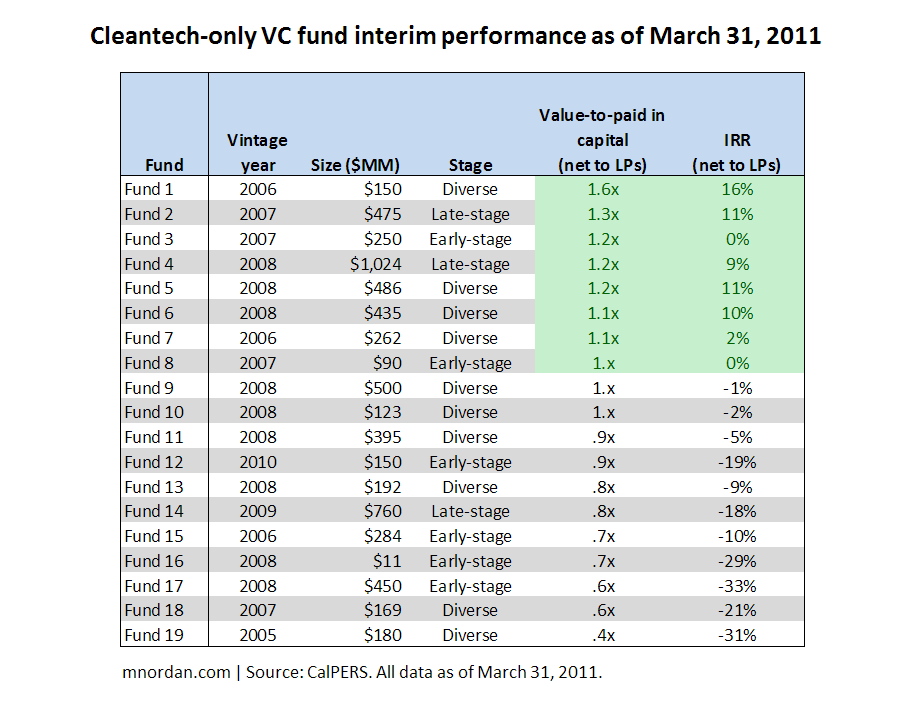
Let’s run through the columns:

  • Fund is an arbitrary identifier for each cleantech-only fund that CalPERS has put money into. While I have anonymized them for this post, CalPERS’s site identifies them by name.
  • Vintage year is when each fund started making investments. This will be important later on.
  • Size is the amount of money that each fund has to invest. This column doesn’t come from CalPERS; it’s culled from press releases. You can use it to see whether big funds or small ones tend to do better.
  • Stage indicates whether a fund tends to invest early or late in portfolio companies’ life cycles. This is also not CalPERS data, but rather my best guess for each fund.
  • Value-to-paid-in-capital is the value of each funds’ investments as of March 31, 2011, divided by the amount of money initially paid for those investments. If I invested $10 in a company two years ago and it’s worth $15 now, my value-to-paid-in-capital is 1.5x. This number is net to LPs, meaning that it accounts for the management fees and the share of profits that the VC fund keeps for itself.
  • IRR is the internal rate of return of the fund – i.e., the performance expressed like an interest rate. If I invested $10 in one company two years ago and it’s worth $15 now, my IRR is 22%. This is also reported as net to LPs.

What do we learn from this?

  • As a group, these cleantech-only funds are slightly “below water” – meaning that their investments are presently worth slightly less than what was paid for them. On a fund-weighted basis, the average value-to-paid-in-capital ratio is 0.95x.
  • Eight out of 19 of the funds, or about 40%, are “above water.”
  • The best fund is at 1.6x value-to-paid-in-capital while the worst is at 0.4x.

This might seem really bad at first glance, but remember that the average fund in this group is only four years old. Venture funds typically run for 10 years, and they almost always exhibit a “J-curve” of performance – meaning that they are under water for their first several years (when some portfolio companies die and go to zero, but the others haven’t appreciated much in value), and they only get above water in the back half. With that in mind, we ask: Is cleantech doing better or worse than VC overall?

As it happens, we can get the data to make this comparison. The National Venture Capital Association publishes the same kind of data that we have above from CalPERS, except that they do it for the entire landscape of venture capital funds. By comparing our cleantech-only fund performance data from CalPERS with our all-of-VC data from the NVCA, we can determine how the interim performance of cleantech-only funds stacks up to VC overall. When we do this, we should only compare funds of the same vintage year, to account for the amount of time that the funds have been running and to rule out year-to-year disruptors like the 2008 financial collapse. The results look like this:
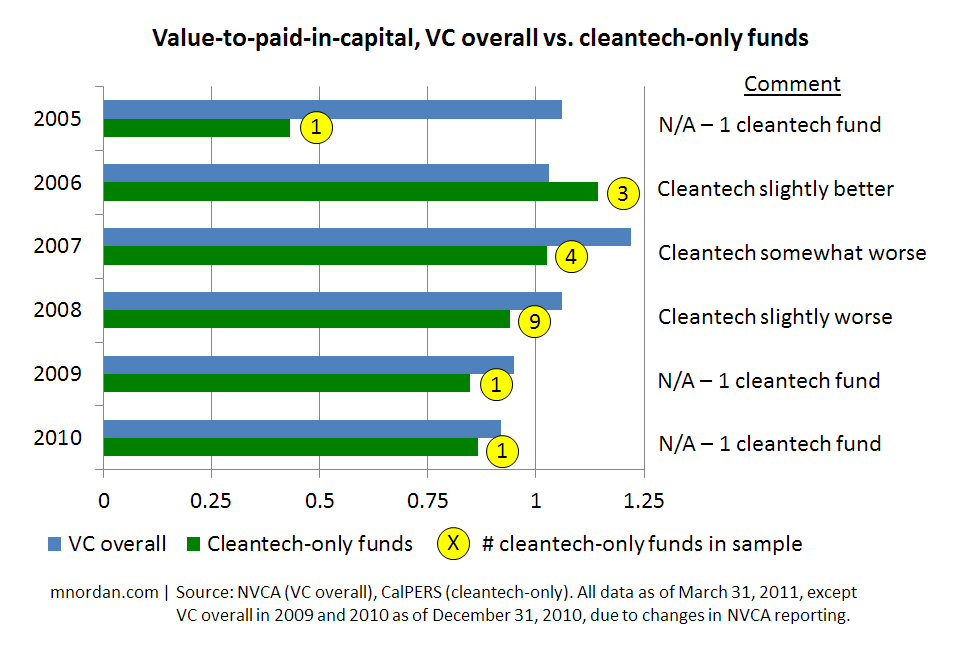
As you can see, we can’t learn much for the vintage years 2005, 2009, and 2010, because in each we’re comparing all of VC to just one cleantech-only fund. But from 2006 through 2008, we have a decent basis for comparison. And you know what? In each case, cleantech is a little better or a little worse than VC overall. Across the entire time period, the cleantech-only funds have a fund-weighted value-to-paid-in-capital ratio of .95x, whereas VC overall is at 1.07x. Given that both values are within ten percentage points of flat – and, moreover, that we are talking about funds that are at most five years old – this is not a large difference.

Further, we’re unfairly handicapping cleantech in this analysis. Why? We’re comparing the entire VC universe with cleantech-only funds. We’ve omitted the cleantech practices of generalist funds like Kleiner Perkins, DFJ, and Khosla Ventures, because there’s no place where we can get data on their cleantech performance carved out from everything else. This impacts our analysis because some of cleantech’s biggest VC-backed IPOs have been supported solely by these generalists – for example Kior, which had Khosla as its lone VC and delivered a $1 billion+ return that only shows up in the “VC overall” side of our comparison.

With this in mind, we can conclude that cleantech VC performance is roughly equal to the VC asset class overall (so far). Reasonable people can argue about whether the whole venture capital shebang is doing well or poorly, but can’t claim that the cleantech bit is bombing.

This analysis has, by necessity, been very investor-centric. What does life look like if you’re a CEO inside one of these cleantech portfolio companies? We’ll tackle that in tomorrow’s post.
Posted in Numbers, The State of Cleantech VC 2011, Venture capital | 2 Comments

The State of Cleantech Venture Capital, Part 1: The Money

(A version of this post also appeared at GigaOM.)

tl;dr: Plenty of late-stage financing will be available for cleantech start-ups over the next few years, but seed/Series A money is another matter.

There’s been a pile of negative news about cleantech start-ups recently. I’ve heard it said more than once in the past month that venture-backed entrepreneurship clearly isn’t working here, so maybe we should all pack our bags and go home. Given the human bias to extrapolate individual events into overarching trends, I figured now would be a good time to review the data so far about cleantech VC performance – and I stress data, not anecdote or assertion! – to see what we can learn.

This is a meaty topic, so I’m going to cover it in four posts. Today I’m going to focus on the money – how much capital has been available for cleantech start-ups so far, and what we can expect in the next few years. Two subsequent posts will address the VC investors that are supplying this cash, as well as the experiences of start-up companies that have achieved liftoff. In the final post, I’ll wrap it all up with some parting thoughts.

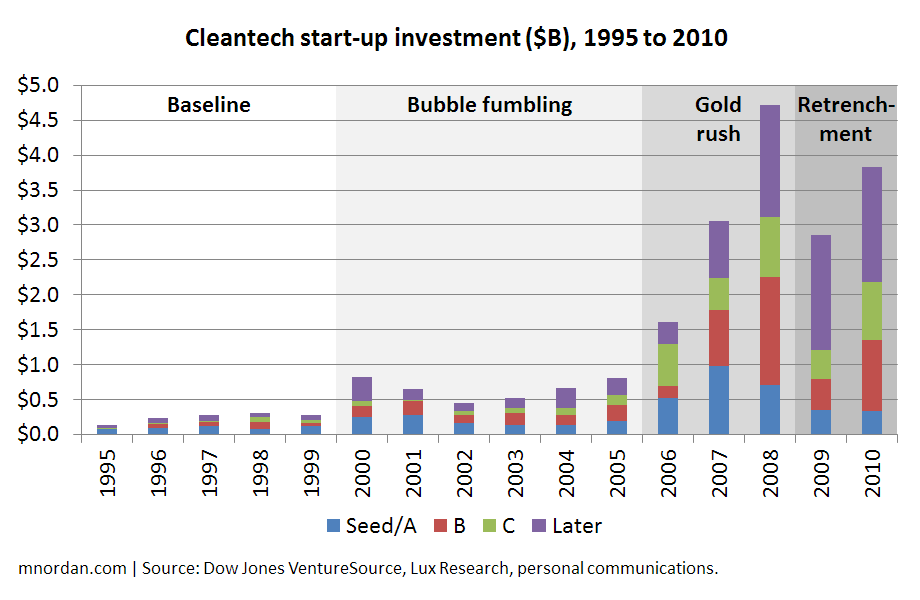
The chart below shows cleantech start-up investment from 1995 through 2010. My data set is cobbled together from multiple sources, aiming to capture the breadth of the energy, environmental, materials, and agricultural technologies that most people refer to when they say “cleantech.” Varying definitions mean that these figures won’t equal those from the Moneytree survey or the Cleantech Group, but the trends should be the same. I divide this era into four periods. During each, cleantech start-up investment had a different driver:

  • 1995 to 1999: Baseline. This period shows us what cleantech start-up financing looks like when there’s no external forcing function to influence it. The answer is $200 million +/- $100 million per year in 30-50 transactions annually. During this period the venture capital industry as a whole grew dramatically – from about $7 billion invested per year to more than $50 billion – so cleantech accounted for a shrinking percentage of the total.
  • 2000 to 2005: Bubble fumbling. The year 2000 saw the peak of the Internet bubble and a commensurate peak in total venture capital investment: An all-time record of nearly $100 billion went into start-up companies that year, mostly of the Internet variety. But the bubble promptly burst, and VC firms that had just raised billions of fresh dollars had to find something other than dot-com start-ups to invest them in. I’d characterize what happened in the years that followed as “fumbling around for another bubble,” marked by broad interest in the physical sciences instead of cleantech per se (you may recall this as the time when nanotechnology became an investment meme). Cleantech benefited considerably from the fumbling, however, and in 2005 start-up investment in the field broke $800 million – several times greater than in the late ‘90s.
  • 2006 to 2008: Gold rush. Starting in 2006, cleantech became a major VC focus area, and start-up financing rose by 50%+ annually for three years. You might think this happened because all the venture capitalists went to see “An Inconvenient Truth” on the same night, but I think a different sort of herd mentality was at work: In Q4 2005, three solar companies went public, all at valuations around $1 billion – namely Q-Cells, SunPower, and Suntech – and hundreds of VC firms hopped on the bandwagon. (You may mock the VC asset class for collectively deciding that cleantech was the next big thing, but you may also respect it for recognizing the intersection of favorable secular trends with a quarter-century of neglected tech innovation!) As a result, cleantech start-up financing skyrocketed to exceed $4.5 billion in 2008. Note that toward the end of this period, after initial bets were placed, money began to shift away from brand-new companies: Seed/Series A financing fell by 29% from 2007 to 2008.
  • 2009 to now: Retrenchment. In September 2008, Lehman Brothers filed for bankruptcy and the stock market went into free-fall, losing 30% of its value by year-end. This spooked investors of all types, venture capitalists included, and cleantech start-up investment dropped by a third in 2009. For entrepreneurs launching new businesses, the more significant development was that Seed/Series A funding fell by half, returning to 2006 levels. 2010 brought a substantial recovery, but not a new peak, while Seed/Series A funding for new start-ups stagnated. As for 2011, the year’s not over yet, but based on current figures this year will be flat or down overall with a level of Seed/Series A investment comparable to 2010.

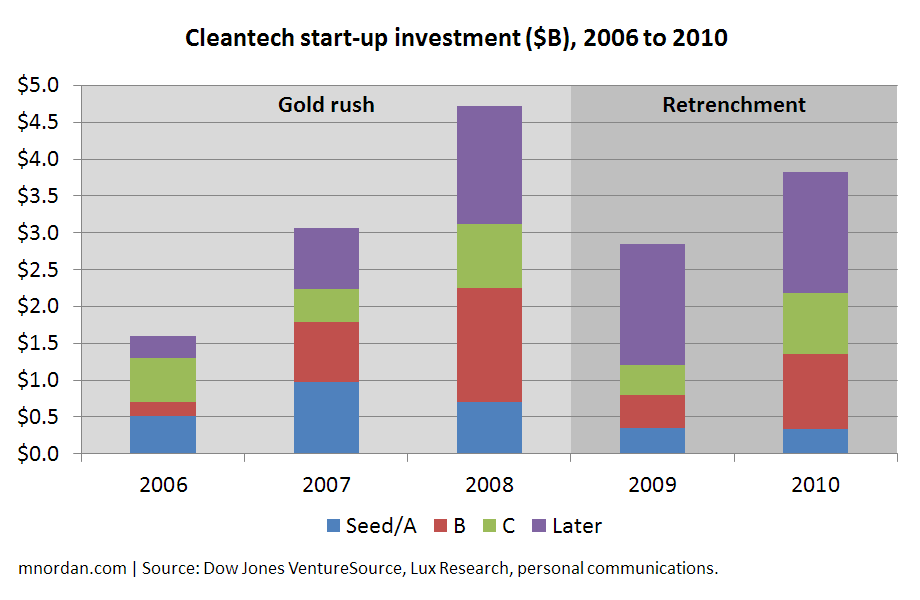
Now let’s zoom in and look at just the last five years. Three big trends come into focus:

  • Financing rose sharply to a peak in 2008 and bounced around after that.
  • Late-stage financing has ballooned as more companies have “graduated” to big Series D and later rounds, where they need lots of cash to build factories, hire sales forces, establish distribution channels, etc.
  • Seed/Series A financing for brand-new businesses has fallen substantially.

So far we’ve been looking at this data by dollars invested. We can also look at it by rounds completed:

This evens out the visual a bit because the late-stage investments aren’t weighted up by their disproportionate value. However, they still predominate: Sixty-six Series D and later rounds were raised last year, more than other stage. In contrast, the number of early-stage investment rounds has plummeted. Nearly 100 new cleantech companies per year received seed/Series A funding in 2007 and 2008, but only 50 or so did in 2009 and 2010.

All of this rear-facing stuff is fine and good, but if I’m an entrepreneur, I want to know what’s going to happen in the future. If my cleantech business will require lots of late-stage capital down the road, what is the competition for that money going to look like?

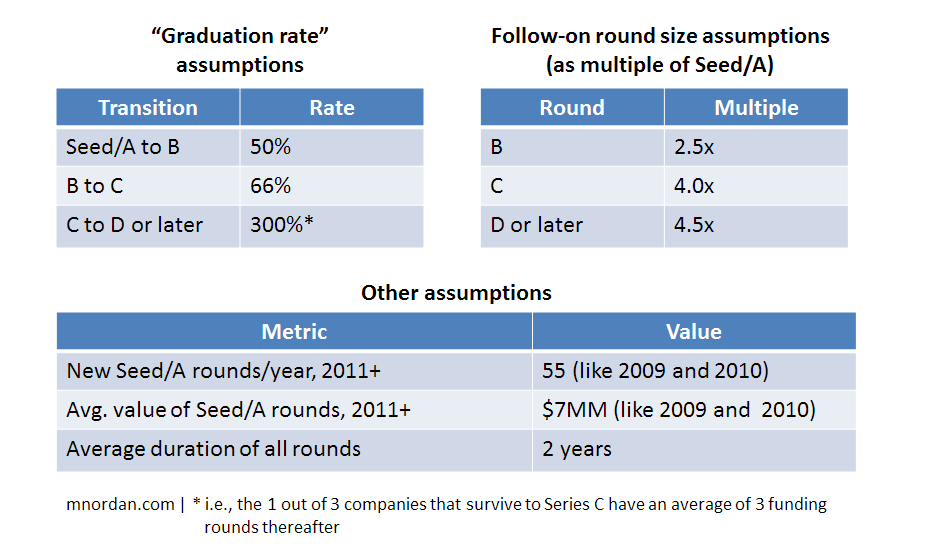
We can answer this question by using yesterday’s financing data to project tomorrow’s capital requirements. We know, historically, the percentage of companies that have “graduated” from Seed/Series A to Series B, B to C, and so on. We also know the proportionate amounts of money that companies tend to raise in each round, and we can make an informed guess at how long each round of funding lasts. Equipped with these numbers, we can build a simple forecast of how much cleantech start-up financing will be required in the future. I used the assumptions below. (One big thing to note: For simplicity’s sake, I’ve assumed that the number of new companies raising Seed/Series A financing each year – as well as the average Seed/Series A round size – will remain at 2009-2011 levels. This obviously won’t happen, but it’s not important to the argument I’m going to make.)

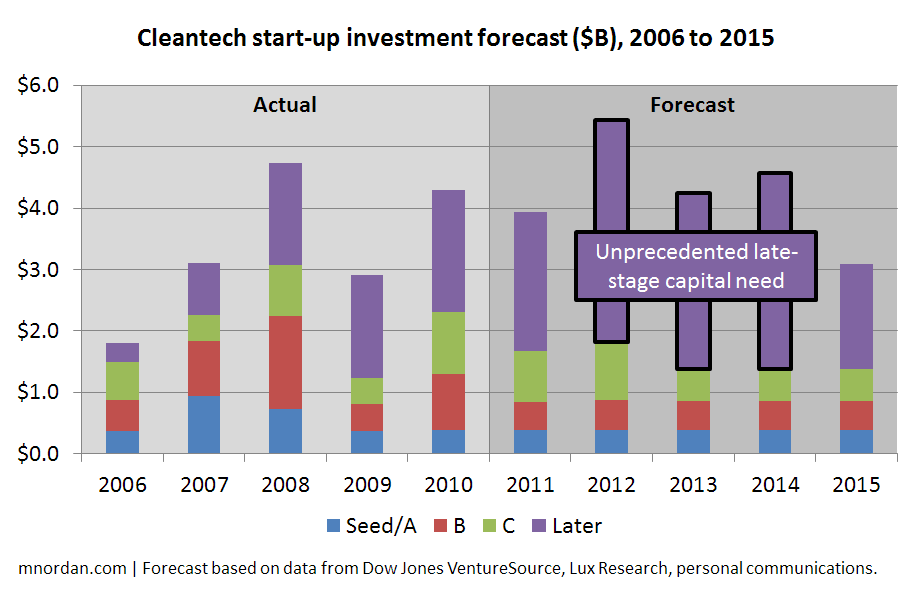
When we apply these assumptions about the future to the population of companies launched in the past, we generate this forecast:

You can see the big takeaway here: There will be a path-breaking requirement for late-stage financing in 2012-2014 as the “baby boom” of companies formed in the last five years plays out. In 2008-2010, an average of $1.8 billion per year went into Series D and later rounds – but during 2012-2014, an average of $3.3 billion per year will be needed. That’s an extra $1.5 billion in late-stage financing annually, or $4.5 billion across the three years.

So will this money be available? Or will otherwise-auspicious cleantech start-ups go begging?

I’m betting that the money will be there. I posit that a number of VC and private equity pros all ran this spreadsheet a year ago, reached the same conclusion, and started raising late-stage funds. Examples include:

The entities above would get you near $4.5 billion all by themselves, and the shift to later-stage allocations among all the other VC investors should be sufficient to cover any shortfall. So I think we can conclude that there will indeed be adequate late-stage financing for cleantech start-ups in the next few years – and happily so, since the need will be unprecedented.

My concern, as you might expect, is that there may be insufficient Seed/Series A capital available to fund new cleantech enterprises. The limited partners who supply VC firms with money to invest are putting less and less capital into VC overall, and the share of that money that will be allocated to cleantech is unlikely to grow in the near term. If shrinking cleantech allocations get disproportionately earmarked toward late-stage investment, Seed/Series A capital will be thin on the ground. I’m self-interested in this because our team at Venrock invests early, we prefer to do so in conjunction with peers, and we already have fewer co-investors available to us now than we did two years ago.

This brings us to a different question: What would have to happen for LPs to pump more money into cleantech rather than the same or less? That depends on returns, which I’ll address in the next post.

Posted in Numbers, The State of Cleantech VC 2011, Venture capital | 3 Comments

Questionable Numbers in Rick Perry’s Energy Plan

tl;dr: Yay for an energy injection into the 2012 primary. Boo for numbers that don’t add up.

In a previous post, I wrote about how we were unlikely to hear substantial discussion about energy in the 2012 Presidential contest unless Texas Gov. Rick Perry became the Republican nominee. It looks like Perry’s playing offense on this issue earlier than I’d expected: He made energy his signature topic at the debate in New Hampshire tonight.

In the first three minutes, Perry opened with his plan to “[put] 1.2 million Americans to work in the energy industry,” and returned to it three times after that. Other candidates spoke about energy only in response to Perry: Rick Santorum piled on shortly after the opening salvo, claiming that “we need to drill” (and making the debatable assertion that Pennsylvania is now the natural gas capital of the U.S.), while Huntsman and Romney made passing comments later on.

So what is Perry actually proposing? All we have to go on is his New Hampshire Union Leader op-ed published this morning. It’s pretty light, so I hope to see more detail soon, but here’s my take:

  • Things that seemed perfunctory: An energy strategy described as “all of the above.” This lays the groundwork for a preordained lurch toward the center should Perry become the nominee, in which case he’d be able to tout his wind energy bona fides.
  • Things I like: Full hydrocarbon production from shale formations. I admit that it’s kind of a cheap point because the free market is taking care of this anyway, and it’s important to note that there are still substantial long-term issues to work through in shale extraction (particularly the cleanup of flowback and produced water from the wells). With that said, natural gas is an important bridge fuel to a low-carbon future and a vital enabler for intermittent wind and solar generation. Finally, it was refreshing to see a candidate use the world “nuclear,” implicitly acknowledging that the U.S. is, in fact, the world’s biggest nuclear generator by a wide margin, and our plants aren’t going away any time soon.
  • Things I don’t like: Drilling in ANWR (a drop in the bucket of consumption with significant environmental cost) and “returning immediately to 2007 levels of permitting in the Gulf of Mexico” – if more stringent safety rules put in place after Deepwater Horizon are slowing down permits for offshore drilling, that’s a delay I’m glad to embrace. Finally, the “job-killing” language with regard to the EPA really rankles: Republicans who claim that CO2 regulation will reduce economic activity would be wise to look to our country’s pioneering application of cap-and-trade to nitrogen and sulfur oxide emissions, where George W. Bush’s Office of Management and Budget calculated that regulation had a net economic benefit.
  • Where I sighed a bit: Perry claims that increasing domestic energy supply will reduce prices, benefitting everybody. I patently dispute this. On the electricity side of the coin, natural gas prices have already been low for some time – and gas accounts for less than a quarter of domestic power production anyway, so marginally cheaper fuel won’t have a noticeable impact. (Plus, electricity prices remain on the low end of the same 8¢ +/- 2¢ per kWh range they’ve been in since 1970.) On the transportation fuel side, crude oil is a global commodity market where U.S. production represents only 11% of supply – so I doubt that we’ll swing prices by growing to, say, 13%.

What I really scratched my head at, though, was Perry’s jobs math. The plan claims that going all-out on mostly-oil-and-gas-plus-some-other-stuff will create 1.2 million new jobs; Perry attributes 425,000 of them to conventional oil production alone (185,000 in Alaska and 240,000 in the Gulf Coast and the Atlantic’s Outer Continental Shelf). But according to the Bureau of Labor Statistics, there are only 179,900 people working in oil and gas extraction in total in the U.S. today. Doubtless the plan expects that there will be lots of pipe-fitters and waitresses ultimately supporting the guys in coveralls – Perry’s number is extremely close to the American Petroleum Institute’s projection of 1.1 million new jobs from aggressive domestic hydrocarbon extraction, a figure that has itself been attacked for implausible exaggeration – but I find it tough to swallow.

Posted in Oil and gas, Policy | Leave a comment

The Smart Grid Debacle and What to Do about It

Found at stopsmartmeters.org

tl;dr: Use less electricity, win valuable prizes.

Look at the picture above. Stare long and hard.

First of all, this is the least-cool protest I’ve ever seen.

Second, is this what the smart grid has bought us? With north of 20 million smart meters deployed in the U.S. and $3.4 billion in ARRA spending committed:

  • Utilities got free money. Twenty million smart meters at $200 a pop means $4 billion; the other 40 million currently planned means $8 billion more to go. You are paying for this – either through your federal taxes (for meters subsidized by the ARRA) or rate hikes in your utility bills (for the rest). Further, most U.S. utilities earn revenue in the form of a regulated return on capital invested, i.e. the physical assets they’ve deployed in the field – including smart meters. So at a typical return rate of 11%, they’d collect an additional $1.3 billion every year for the smart meters they’ve deployed.
  • Vendors made bank. Take a look at Silver Spring’s S-1. Scroll down to the financials and you’ll find $422 million in deferred revenue. Again, your dollars at work.
  • Consumers got worse than nothing. These smart grid investments are supposed to lead to lower prices, better reliability, and more choice. But so far, consumers are seeing little more than ham-fisted rollouts and lightning-fast disconnections if they fail to pay their bills. In this environment, it’s no surprise that largely unsubstantiated fear-mongering about smart meter safety and privacy attracts a growing following.

Don’t get me wrong: Smart grid infrastructure is a vital requirement for the future. But the process of selling it to consumers has, by and large, been awful. At this rate, the utility industry risks permanently alienating multiple generations of people who are all coming face-to-face with energy technology for the first time. If backlash against the smart grid rippled up through public utility commissions to elected officials, it could permanently scuttle future initiatives – a phenomenon already hinted at in Hawaii and Maryland.

If you envision the same kind of future I do – one where the stuff you plug into the wall responds transparently to grid conditions to help balance supply and demand – it will never be realized in the face of popular disdain. In my view, reversing consumer perceptions of the smart grid will require:

  • Blindingly obvious consumer benefits. Getting a smart meter shouldn’t be like putting in a new smoke detector – it should be awesome, more akin to unpacking a new iPhone. Benefits like faster outage recovery and deferred transmission construction are too infrequent and vague for consumers to care about, so what can be done? 1) Build simple apps to show consumers their energy usage, 2) suggest what they can change, 3) fund prize pools for those who reduce the most, and 4) trumpet the giveaways Powerball-style. This is proven to work elsewhere – witness companies like HealthHonors and HealthPrize, which give cash prizes to people for taking their prescription drugs.
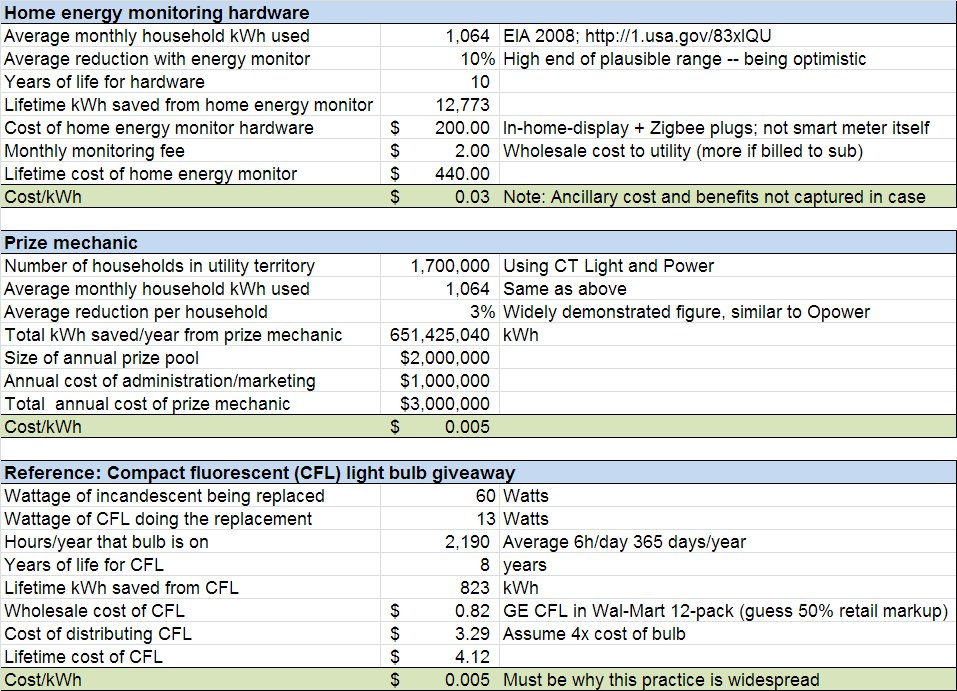
  • Super-low cost. Most utilities have an incentive for consumers to use less electricity, in the form of money they get paid by public utility commissions for every kilowatt-hour reduced. Utilities must deliver the reduction at the lowest cost per kWh. It’s going to be less costly (and, I suspect, more effective) to do this via cheap prize mechanics rather than deploying yet more costly hardware. My quick-and-dirty math below shows why: If a $200 home energy monitor with a $2/month subscription fee yields a 10% electricity reduction, that works out to $0.03/kWh reduced. But if a $2 million prize pool (let’s tack on another $1 million in administration/marketing) gets customers to use 3% less across a 1.7 million household base (I used CT Power and Light), you’re at less than half a cent/kWh – an order of magnitude lower, and on par with tried-and-true CFL bulb giveaways.

  • A marketing infusion. To date, smart meters have been the consumer face of the smart grid. Their rollouts have been frequently unfortunate. One much-discussed California utility began deploying smart meters during a blazing summer amidst a change in rate plans: Can you blame angry consumers for thinking that the new meters jacked up their bills? Smart grid initiatives need to be managed like products, stress-tested by PR paranoiacs, and marketed by savvy tacticians recruited from the likes of P&G and Apple.

With this in mind, what am I excited about as an early-stage venture investor?

  • Competitions. The Biggest Energy Saver competitions in Texas and San Diego are probably the best examples of this, and the ideal market-testing playgrounds for start-ups with behavioral approaches. Lucid Design Group has done a great job of setting up similar competitions for university and corporate campuses.
  • Software disambiguation. I don’t know what I’d do if my smart meter said I use, say, 20% more electricity than similar homes. I do know what I’d do if I was told “the problem is your fridge.” Within a few years, smart meters in California and Texas will start chirping electricity consumption data wirelessly to any device in the home: While there are plenty of logistical wrinkles to iron out, the idea of using algorithms to work out the contribution of each individual load – and make personalized recommendations about what to change – is tantalizing. A bunch of start-up companies are on the case.
  • “White tag” markets. In nearly all states, if a company wants to harness smart meter data to enable household electricity reduction, it has to contract with a utility in order to get paid. Utilities can only take on so many of these projects at a time, and they pose notoriously long sales cycles that are poison for start-ups. A better way to encourage innovation would be to establish an open market for residential energy savings credits (“white tags”) and let anyone participate, as long as verified reductions can be demonstrated. This process is underway in Connecticut, Pennsylvania, and Nevada, although it seems to be a long time coming.

A final note: Successful innovation here (at least in the U.S.) is more likely to come from the bottom up than the top down. Americans don’t like being forced to do something, and get outright hostile when they think you’re invading their homes: As National Rural Electricity Co-Op Association VP Jay Morrison said at Gridweek this month, “What Glenn Beck has taught us is that if the government says we have to install something, people will resist it.” Make the smart grid awesome for consumers – using prizes, games, and competition to win a battle for attention – and people will engage on their own.

Posted in Consumers, Smart grid | 3 Comments

What It Takes to Build a Cleantech Winner

(A version of this post also appeared at Fortune.com. Thanks Dan!)

tl;dr: It’s the team.

I entered the venture capital business two years ago, focusing on seed/Series A cleantech start-ups. It’s kind of like picking a future NBA draft by watching eighth graders play basketball: There are many years’ worth of development to go, and the subjects will look a lot different once they’re all grown up. The key is excellent pattern recognition – identifying the antecedents of success long before it happens.

Pattern recognition is vital for entrepreneurs, not just VCs – if you aim to succeed, it helps to know what other successes have looked like!

Most of my fellow cleantech VCs came to this field from some other domain – often semiconductors or telecom – and brought their pattern recognition biases along with them. The question I found myself asking was “what if everyone’s biases are wrong?” What if we’re picking the wrong eighth graders?

Coming from a career in the tech analyst business, I wanted to find a fact-based way to answer the question, so I assembled a well-defined set of successful VC-backed start-ups and looked for what they had in common. I picked companies that:

  • Had achieved unambiguous success, which I defined as an IPO on a major exchange. That’s far from a perfect criterion, I know, but at least it’s clear-cut.
  • Went public after 2000, to rule out the boomlet of ’98-’99 energy IPOs (when the Internet bubble’s rising tide lifted all boats).
  • Were backed by institutional venture capital. Note that the majority of public cleantech companies have, in fact, not been venture-funded.

As of today, this sample consists of 18 companies:

Data table(Doubtless there are errors in this data, so please point them out in the comments and I’ll make corrections in a batch. To pre-empt one item, however, note that I included predecessor companies in each firms’ history, which explains First Solar’s founding date.)

What can we learn from this? The average NBA draft pick of cleantech:

  • Raised $122 million in equity financing, which excludes grants and debt. The distribution is pretty broad, but I’d note that if you remove Q-Cells and REC as special cases, the floor is ~ $30MM. If a new business plan poses a lower lifetime cash requirement, there should be an airtight argument to justify that claim.
  • Went public at a ~ $900 million valuation, also with a broad distribution. If you assumed that investors owned, say, 80% of these companies at the IPO, the lot would have delivered a 5.9x return on capital invested.
  • Took 8.3 years from founding to IPO. If you’re signing up to build a cleantech winner, reserve a decade of your life. Note, however, that this elapsed time has shortened for companies that have gone public since 2010, where it averages 6.7 years. Start-ups in this later group received venture financing either right at their founding or soon after it, in contrast to earlier companies which often bootstrapped themselves for years before taking venture capital.
  • Survived a 1-in-50 success rate. These 18 companies received their first venture investment between 1995 and 2007. A quick Venturesource search indicates 986 seed/Series A rounds done in cleantech during that period. While there are doubtless further successes to come, particularly from start-ups funded in the later years, the yield so far is 18 / 986 or 1.8% of start-ups funded.

If we include some financial metrics, we learn a bit more. The average cleantech winner also:

Data table

  • Went public on $72 million in revenue the prior year. With a couple of outliers (SemiLEDs and Gevo), the revenue floor for an IPO has been around $30 million since 2007. This has led to price-to-revenue valuations at IPO in the double digits, transcending their category comparables (for example, A123Systems is still at 4x P/S today despite two tough years, while incumbent battery-makers Exide and Enersys sit well under 1x). Winning cleantech start-ups get valued like high-growth tech companies, not like their incumbent peers, so the latter haven’t informed IPO valuations.
  • Was unprofitable at IPO. Only four out of 18 companies – Q-Cells, REC, Solarfun, and Yingli, all in solar – showed an operating profit in the fiscal year before they filed. That situation remained unchanged in the year of the IPO itself, where most companies’ losses widened rather than narrowed.

This analysis tells us what the NBA draft looked like, but it doesn’t say anything about the eighth graders. To learn about them, we need to do some primary research. Here’s how I went about it.

I talked to as many people as I could who were familiar with these 18 companies at their earliest stages. I asked them a simple question: “At the time of the seed/Series A fundraise, how would you have rated [company X] on its technology, its market, and its team – great, middling, or unfavorable?” For each start-up, I strove to speak with at least one investor who did the seed/Series A deal as well as at least one who saw it and passed; however, for many companies I couldn’t pull this off – so let me emphasize that there’s a heaping helping of subjectivity here. With that caveat in place, here were my results:

  • Technology doesn’t correlate with success. At the timing of early-stage financing, only about a third of these companies were real technology leaders with strong, differentiated IP (think Evergreen Solar in 1994). If you made picks based on technology alone, you’d have ruled out most of these companies.
  • Market attractiveness was anticorrelated. Eight of these 18 firms faced unattractively small markets early on: Demand response was hardly a hot category when EnerNOC and Comverge formed in 2003,  electric vehicles evoked little more than the EV-1’s failure at Tesla’s 2002 founding, and Reagan took the solar panels off the White House two years after First Solar’s predecessor Glasstech started up. Another six firms faced middling markets that were large in absolute terms but exhibited some deal-killing attribute, like low/volatile category margins (chemicals, fuels) or ruthless Chinese competition (batteries, LEDs). In most cases, the bit-flip from an unattractive market to an attractive one was driven by regulation (feed-in tariffs for solar, forward capacity markets etc. for demand response, and subsidies like the Renewable Fuels Standard for biofuels).
  • Team matters most. The best predictor of success for this group was a killer team, present from the outset in a majority of these companies. (From my interviews, only one of the 18 was a “we’ll fund if the CEO gets replaced” situation.) The most important observation for me is that, most of the time, the founding CEO was the same one who rang the stock exchange bell years later: Eleven out of 18 never changed CEOs, two started life without any CEO and added one along the way (in both cases the founders stayed on), and only five changed leadership midstream. I frequently hear some of my energy VC peers say that there’s so little executive talent in this sector, replacement CEOs must be recruited as a matter of course; the facts don’t support that view.

So – faced with the daunting task of predicting cleantech’s NBA draft eight years’ hence – what am I looking for?

I’m looking for a great team – people who can defy intimidating odds and who show, rather than tell, how they will shape the world to match their will. I accept that additions will be made over time, but I have to believe that the people in front of me can drive a very large outcome in the roles they’re in now. I don’t care whether the market they’re selling into is big today, but I need to be compelled by their vision of what will change to make it attractive during the period of investment. (That forcing function is probably may often be regulatory.) Finally, no matter how impressive the technology is, I won’t compromise on the people (although I’m likely to accept a tradeoff in the opposite direction).

That’s just my take, and I’m fully aware that the error bars around this analysis are huge. But if you agree with any of it, it follows that the best thing cleantech investors can do is attract the brightest minds to this domain. This should be the greatest creative and collaborative focus of our fledgling community.

Posted in Numbers, Venture capital | 7 Comments